The Chinese EV Blitz: Testing the BYD Sealion 7 Amidst an Eight-Car Summer Assault
Automotive start-ups are materialising in China at a genuinely dizzying rate, churning out fresh models just as quickly as they draw up the blueprints. BYD, however, is making particularly short work of its European expansion. Far from a cautious rollout, the brand is orchestrating a massive summer offensive, preparing to unleash eight new vehicles across three of its bespoke sub-brands. The focal point of this invasion is the Goodwood Festival of Speed, an event increasingly hijacked by Chinese manufacturers keen to park their latest hardware alongside established European royalty. The roster they are bringing is frankly absurd. You’ve got the Denza Z making an appearance in both a sleek street coupé guise and a rather unhinged racing spec sporting a colossal rear wing. Thanks to a tri-motor setup, it’ll happily crack 216 mph, effectively dragging European sports cars through the mud off the line. Then there’s the Denza Bao 5, a hefty SUV mating three electric motors with a petrol turbo, and the Denza D9 DM-i, a hybrid people-carrier aimed squarely at large families. It’s a stark reminder that BYD isn’t blindly wedded to pure electric propulsion over here; they’re hedging their bets with plug-in hybrids like the diminutive Dolphin G supermini and the Shark pickup. Rounding out the madness is the Yangwang U9 Extreme, a ludicrous all-electric hypercar boasting a Nürburgring record that feels custom-built to tempt buyers with bottomless pockets.
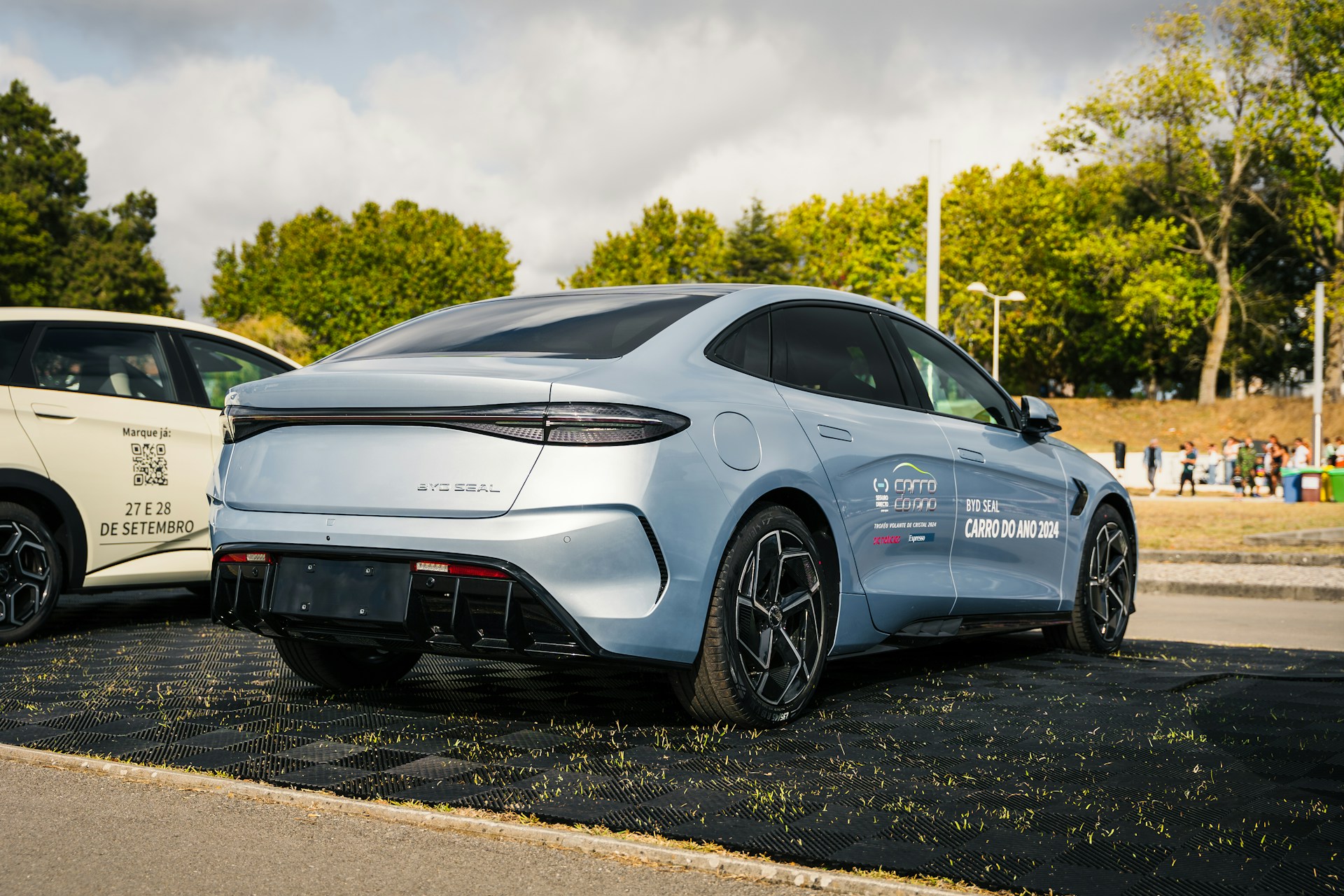
But away from the multi-million-pound hypercars and hybrid behemoths, BYD knows exactly where the actual money is printed in Europe: the £50,000 mid-sized all-electric crossover segment. Enter the BYD Sealion 7. Tasked with elbowing its way into a crowded scrap already dominated by the Tesla Model Y, Hyundai Ioniq 5, and Polestar 2, it is supposedly the vanguard of a new family of Sealion SUVs. Although, BYD hasn’t actually confirmed if this ‘7’ is the ceiling for their size, or if even larger barges are looming on the horizon. As it stands, it certainly isn’t a small vehicle by the standards of its own class.
Positioned as the taller, inherently more practical cousin to the Seal saloon (think Model Y to the Model 3), this is BYD’s fourth pure-EV to hit the UK. Crucially, it shouldn’t be confused with the Seal U, which is a slightly smaller and mechanically disparate beast. The Sealion 7 shares virtually the same footprint and wheelbase as the saloon, sitting at a fairly low-slung 1620mm tall—a shade lower than a VW ID.4. With a ground clearance of just 163mm on the top-tier Design AWD model, it’s clearly not built for bouncing down a rutted green lane. Underneath, though, it’s packing serious tech. Built on an evolution of the brand’s e-Platform 3.0, it pushes on-road performance and rapid-charging capabilities to new heights. The top-flight Excellence AWD version adopts a proper 800V electrical architecture to juice its 91.3kWh battery at serious speeds.
The rest of the range, including the entry-level single-motor Comfort spec we elected to test, utilises an 82.5kWh setup. BYD remains stubbornly committed to its proprietary lithium-iron-phosphate (LFP) ‘Blade’ batteries, shunning the industry-standard nickel-manganese-cobalt (NMC) cells. It’s a clever bit of packaging: the cell-to-body setup acts as a stressed structural component of the steel unitary chassis, rather than just isolated dead weight slung underneath. Plus, BYD claims these LFP cells promise better longevity over thousands of charge cycles, hold up incredibly well in freezing weather, and completely bypass the ethical minefield associated with cobalt mining.
On paper, then, it has the chops. Scoring a solid 7 out of 10 for styling, it arguably carries much more design charisma than a fair few of its homogenous Chinese rivals. But does it actually hold together on British tarmac? Handing out a somewhat lukewarm overall rating of 6, we found the Sealion 7 isn’t quite the swish, sophisticated premium EV the marketing brochures promise. It has undeniable perks, of course. Cruising at motorway speeds, the cabin is remarkably quiet, and the seats are sumptuously comfortable. We also know that if you stump up for the dual-motor derivatives, the sheer torque will hurl you well into the realms of the purely excessive.
However, the execution feels clumsy where it truly matters. The ride and body control are notably poor, leaving the heavy chassis wallowing over broken road surfaces. It also loses puff rather drastically when the battery state of charge drops low. Despite the impressive architectural claims, it feels surprisingly inefficient in the real world, and rapid-charging speeds on the standard models feel a bit off the pace given the battery capacity it’s lugging around. Factor in a maddeningly poor cabin control layout and some fiercely annoying Advanced Driver Assistance Systems (ADAS), and it leaves you feeling rather conflicted. It’s a vehicle built on undeniably brilliant foundational technology, yet somehow, it trips over its own shoelaces in the final, crucial miles of development.